Can AI Build a Website? An Honest 2026 Guide

You have probably seen the ads by now: describe your business in one sentence, and an AI website builder hands you a finished website in minutes. The claim is mostly true. In 2026, you really can type a few sentences about your business and get back a working website with pages, layout, copy, and a contact form, usually in under ten minutes. What the ads leave out is everything that happens after that first draft. This guide gives you the honest picture: what AI builders do well, where they fall short, and the five questions that settle whether to use one or hire a designer.
- The Short Answer: Yes, With a Catch
- What AI Website Builders Actually Do
- What AI Builders Do Genuinely Well
- Where AI-Built Websites Fall Short
- What Does It Cost? AI Builder vs a Designer
- When Hiring a Designer Pays for Itself
- Five Questions That Settle It
- Building With AI Anyway? Do These Six Things First
The Short Answer: Yes, With a Catch
Yes. If you describe your business in a few sentences, an AI website builder will hand you a working website with pages, layout, copy, images, and a contact form, usually in under ten minutes. Wix says its builder generates the pages, layout, and copy for a whole site in a few minutes. When Forbes Advisor gave eighteen builders the same prompt for a guinea pig grooming business, Hostinger's builder picked up the booking tool, contact details, reviews section, and extra pages on the first try.
But a working website and a website that brings in customers are two different things. What you get is a first draft. The copy sounds generic, the search setup is still on you, and the site stops improving the day you stop working on it. Webmakeria watched weekly Google clicks climb from 8 to 44 while an AI agent ran its content and SEO in two-week sprints, then saw 28-day clicks fall from 142 to 87 when the sprints paused for the summer, as reported in its published experiment. The draft is real. The rest of the job is real too.
What AI Website Builders Actually Do
You answer a few questions or write a prompt about what your business does and who it serves. The builder picks a page structure that suits your kind of business, writes the copy, and chooses images, colors, and fonts. Then you customize the result, either by asking the AI for changes in plain English or by editing by hand. Most builders also host the finished site, so publishing is one button. The big names are Wix, Squarespace, Hostinger, Framer, Durable, and 10Web.
What AI Builders Do Genuinely Well
Start with the honest wins, because there are real ones. Speed is the obvious one. A presentable one-page site in an afternoon is a genuine outcome, and for a business testing an idea, or one that mainly needs an address, hours, and a phone number online, that is a good result.
Cost is the second. Most AI website builders will publish a small business site on your own domain for roughly $10 to $40 a month on annual billing. Wix's Light plan is $17 a month billed yearly, Framer's Basic plan is $10 a month, and Hostinger starts at $2.99 a month on a 48-month term paid up front, renewing at $10.99. Prices move often, so check the provider's own pricing page before you budget.
The technical floor is higher than people expect. Hosting, SSL, and software updates are handled for you on the big platforms. In WebAIM's 2026 study of the top million home pages, Wix and Squarespace home pages averaged about 33 detected accessibility errors, against an average of 56.1 across all pages. And the blank page is gone: the draft gives you a structure to react to, and reacting is faster than inventing.
Where AI-Built Websites Fall Short
It looks like your competitors' sites. AI builders work from patterns. Describe a dental clinic and you get the dental clinic pattern: smiling stock photo, three service cards, a testimonials slider. Your competitor typed something similar last month. It looks finished, which is the trap.
The copy sounds right and says very little. One marketer who built a webinar page in Wix Harmony called the first text pass competent but generic, and rewrote about 60% of the body copy by hand, according to AI Marketing Focus. The copy can also be confidently wrong: Google Search Central notes that generative models predict a likely sequence of words rather than retrieving facts, so manual fact-checking before publishing is critical.
It does not know what a lead is worth to you. A generator does not know that your best clients come through WhatsApp, or that a booking request is worth ten newsletter signups. So you get a generic contact button and a form with too many fields. Conversion work is mostly unglamorous decisions, and someone has to make them. The AI does not ask.
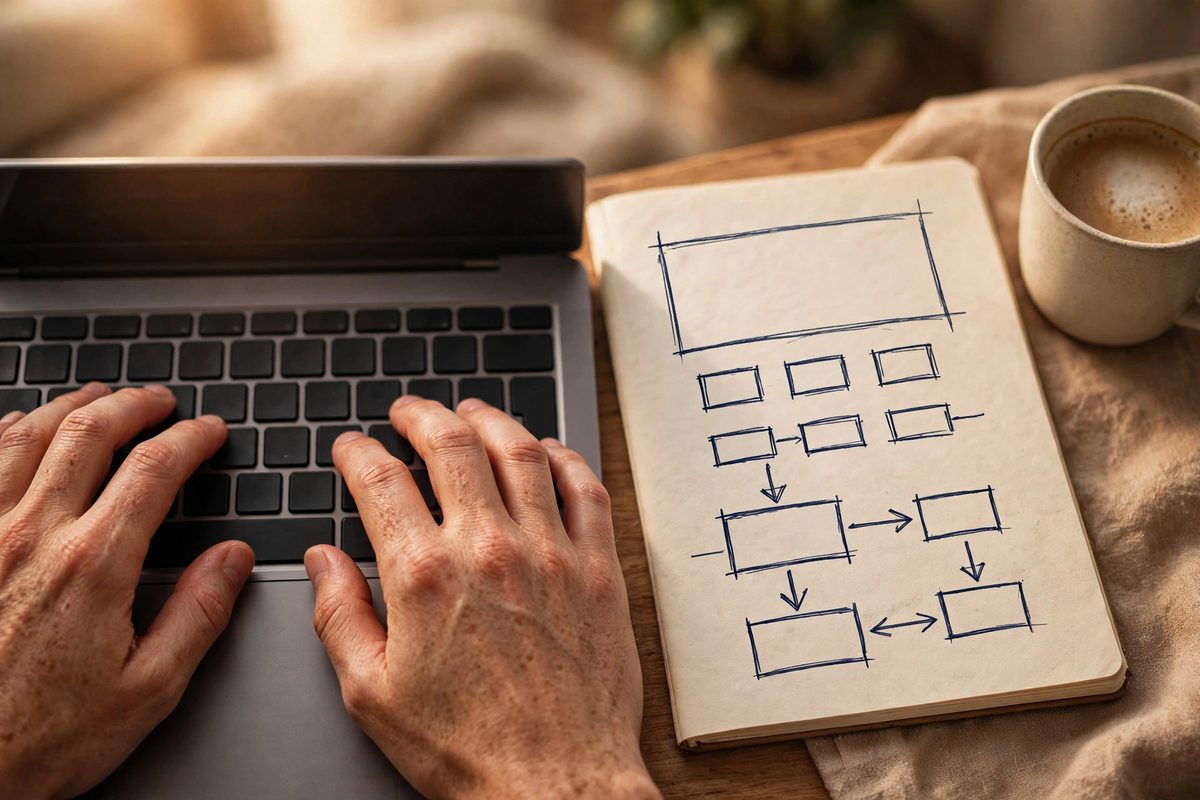
The SEO basics depend on decisions nobody made. The tools exist: editable titles, sitemaps, and on some platforms structured data and redirects. The gap is that a tool does not decide anything for you. Someone still has to work out which pages you need, what each page should target, and how they link together. Google says AI content gets no special gains and no penalty either: what matters is whether it is original, helpful, and trustworthy. The biggest risk is replacing an existing site: launch a fresh AI-generated site with new URLs and no redirects, and your old rankings can disappear.
Performance and accessibility get worse as you customize. Google's Core Web Vitals say a good page should show its main content within 2.5 seconds, respond to a tap within 200 milliseconds, and keep layout shift to 0.1 or less. AI-generated designs love full-width video backgrounds, big hero images, and carousels. On a mid-range phone on mobile data, they add up. The same WebAIM report found 95.9% of home pages had detectable WCAG failures, most often low-contrast text, images missing alt text, and form fields without labels.
Leaving can mean starting again, and your time is not free. Wix's own help centre explains that a Wix site has to be hosted on Wix's servers. Squarespace lets you export some content as a WordPress XML file, but store pages, product blocks, and custom CSS do not come with it. As for time, the demo takes five minutes and the real thing takes evenings and weekends. Curtis Matthews built two sites with ChatGPT in about an hour each, then spent about another hour per site on the domain, Search Console, sitemaps, and indexing, as he documents in his ChatGPT Sites SEO test. Add up those hours at your own rate and the cheap option often is not.
What Does It Cost? AI Builder vs a Designer
The sticker price is only part of it, because nearly every builder also meters AI credits, and no two meter the same unit. In Forbes Advisor's test, building one simple site used all 5 of Hostinger's base-plan credits and nearly all 50 of GoDaddy Airo's. If you expect to keep refining the site by asking the AI for changes, check how many credits a plan includes.
A designer costs more up front, and the honest way to compare is cost over the first year, not the launch price, and what each option returns. BDC reports that Canadian businesses with less than $2 million in annual sales invested an average of $19,652 in their website over the last three years. If you would rather know the number up front, see our fixed-price packages for what a professionally built site costs with us. Our guide on how much it costs to hire a web designer breaks down freelancer and agency rates in detail.
When Hiring a Designer Pays for Itself
Hiring pays for itself when the website is a working part of the business rather than a brochure. If leads, bookings, intake, or sales run through it, every structural weakness costs you money quietly. The spend returns when the site is your main lead source, you compete in local search, something has to connect to it like booking, payments, or a CRM, or you are content-heavy. A designer decides what the website has to do before deciding what it looks like, and that decision work is the part a tool cannot do for you. If that sounds like your situation, look at our web design services and what a build includes, and read our guide to hiring a freelancer vs an agency if you are still deciding who should build it.
Five Questions That Settle It
If your site is not your main source of customers yet, building it yourself is often the right call. These five questions settle the rest, and our honest comparison of building your own website versus hiring a designer walks through the same choice in more detail.
1. Is the website your main source of new customers? If people find you through search, directories, or ads before they call, the site is sales infrastructure, not decoration.
2. Does anything need to connect to it? Online booking, payments, a CRM, client intake, or inventory all push the project past what a builder handles cleanly.
3. Are you competing in local search against established sites? If three competitors have been ranking in your city for years, structure and local SEO decide whether you appear at all.
4. Who maintains it twelve months from now, and do they have the time? DIY only works when someone keeps doing it. Be realistic about the week you actually have.
5. What is one new customer worth, and how many would pay back the build? If two or three jobs cover it, the decision usually answers itself. Three or more yes answers means hiring a web designer will likely pay for itself. Fewer means build it yourself now and revisit in a year.
Building With AI Anyway? Do These Six Things First
1. Rewrite the generated copy with your real details and delete any claim you cannot back up.
2. Write your privacy policy for what you actually collect, or get help with it.
3. Check text contrast, add alt text to images, and give every form field a visible label.
4. Test the contact form from your phone and confirm the email arrives.
5. If you are replacing an old site, list its URLs and set up redirects before launch.
6. Keep your text and images in your own files, so a future move is easier.
AI changed the floor, not the ceiling. Anyone can now get a decent-looking page online in an afternoon. What AI has not changed is the harder work: deciding which pages exist, what the offer says, and whether your business shows up when someone in your city searches for what you sell. If you want an honest read on which side of that line you sit on, talk to us and tell us what your business does.
Frequently Asked Questions
Can AI build a website for free?
You can often start for free. Wix, for example, lets you generate a site at no cost but needs a paid plan to connect your own domain or take payments. Every free plan puts the site on the builder's own address and almost all of them add the builder's badge. For a business, budget for a plan, a domain, and your own time.
Are AI website builders good for SEO?
The platforms give you the basic tools, such as editable titles, sitemaps, and on some, structured data and redirects. What they do not do is the strategy: deciding which pages you need, writing content that answers real questions, and protecting existing rankings when you replace a site. Google gives AI-written content no special gains and no penalty. What matters is whether it is original, helpful, and trustworthy.
Will AI replace web designers?
It is taking over the first draft and a lot of routine production work, and designers use these tools themselves. The judgment about what a business needs from its site, the decisions about structure and conversion, and the accountability when something breaks still sit with a person.
Can I start with an AI builder and hire a designer later?
Yes, and for a new business it is a reasonable path. Keep your content in your own files, note your page URLs, and expect that leaving a hosted builder usually means a rebuild. A good designer will plan redirects so you keep the traffic you have built.

Muhammad Usman designs and builds high-converting websites for small businesses — and writes practical guides like this one from real project experience.
Keep Reading

Should You Build Your Own Website or Hire a Designer? An Honest Comparison
How Much Does It Cost to Hire a Web Designer in 2026?

Hiring a Freelancer vs an Agency for Web Design
Need a Website That Actually Performs?
Fixed pricing, professional build, live in weeks. Tell us about your project — free strategy call, no pressure.